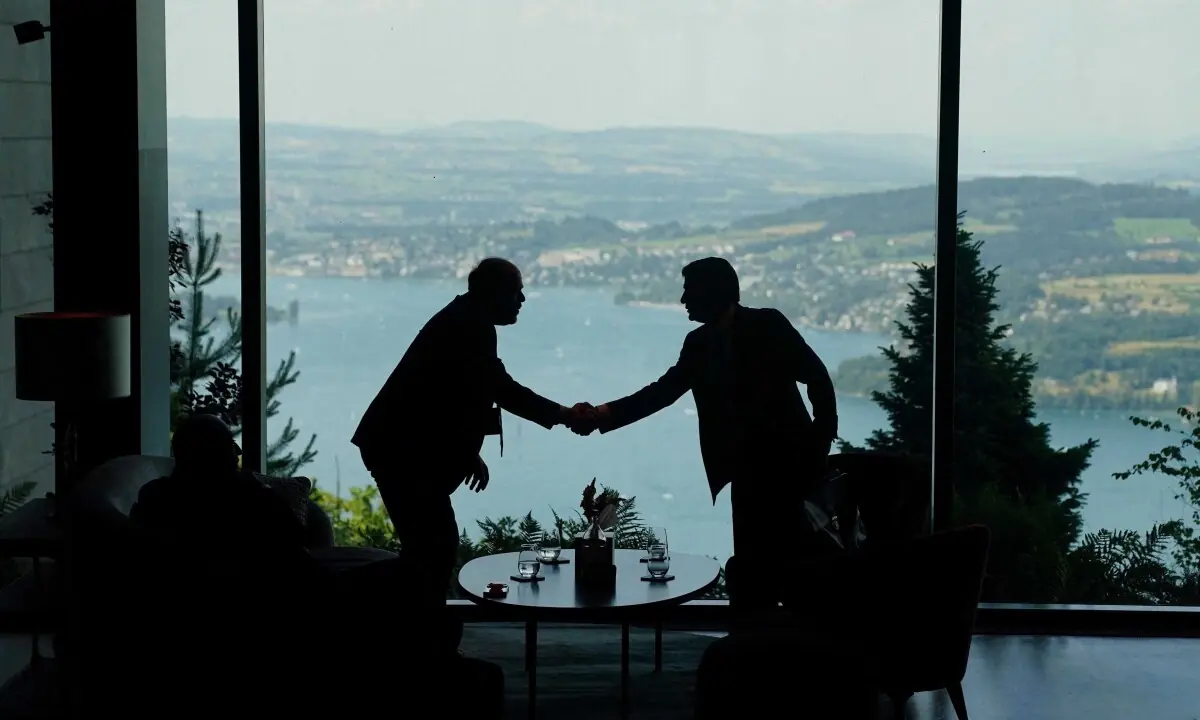
After hours-long negotiations in the Swiss resort of Burgenstock, the US and Iran agreed on a roadmap towards reaching a final peace deal in 60 days, a joint statement issued by mediators Pakistan and Qatar said on Monday.The talks began on Sunday and stretched into Monday, being held under the framework of the Islamabad Memorandum of Understanding that was signed between the two sides on Thursday. Prime Minister Shehbaz Sharif also signed the breakthrough interim peace deal as a mediator, marking a significant step towards end a war that began in late February. The joint statement issued by Pakistan and Qatar after the second round of direct talks between the two sides — the first having been held in Islamabad in April — said the first session of high level talks under the framework of the Islamabad MoU had concluded with the participation of representatives from Iran, the US and the mediators.“The Lake Lucerne Summit was conducted in a positive and constructive atmosphere. Encouraging progress has been made including the creation of a mechanism for further technical talks,” the statement read.It added that building on the Islamabad MoU, the two sides had agreed to the establishment of a high-level committee, “which will provide political oversight on the mediation”.“Chief negotiators will report regularly to the high-level committee and lead working groups focused on nuclear and sanctions [issues], and a monitoring and dispute resolution group to ensure the effective implementation of the MoU, and on other matters,” it said.According to the statement, the high level committee had agreed on a roadmap towards reaching a final deal within 60 days, laying the foundation for the immediate commencement of further technical talks.In addition, a communication line between the US and Iran would be established for 60 days “to avoid incidents and miscommunication with the aim of safe passage for commercial vessels through the Strait of Hormuz”.The joint statement said both sides had also agreed on the creation of a “de-confliction cell, between the parties, the Lebanese Republic and facilitated by the mediators, to ensure the adherence of the termination of military operations in Lebanon as per the MoU”.“Technical talks will continue for the remainder of the week at the Burgenstock resort on all issues,” it added. “The mediating parties will continue to do their utmost to ensure that the negotiations continue to be conducted in a constructive atmosphere with the aim of reaching a final deal.”Concluding the statement, the mediators appreciated the US and Iran for their “ongoing commitment to diplomacy and a peaceful resolution to the conflict”.“The mediating parties further commend brotherly and friendly countries for their continued support and valuable contribution to the ongoing negotiations,” the statement read.Soon after the foreign ministries of Pakistan and Qatar posted the joint statement on X, Iranian Foreign Minister shared it on his account, saying: “Tireless Pakistani and Qatari mediation has delivered major progress to end Lebanon War. Oil and petrochem exports are waived, blockade lifted, some frozen assets released, and major reconstruction and development plan launched for Iran.“1st real test: Lebanon deconfliction cell.” Earlier, an American official said several key issues, including “all elements of the nuclear deal” with Iran, were discussed during the talks.“We’ve had robust discussions on all elements of the nuclear deal,” the official said, speaking of a key sticking point between the two sides.The official detailed that the discussion also covered “clarifying some of the confusing messaging from Iran on the Strait [of Hormuz] and building deconfliction mechanisms to ensure the strait will remain fully open. We have also worked through deconfliction mechanisms and enforcing the ceasefire in southern Lebanon”.“We plan to continue working through each of these issues and using today’s work as a starting point for ongoing technical talks going forward,” the official said.Closed-door negotiationsClosed-door quadripartite negotiations between the US and Iran kicked off earlier today, with Qatar and Pakistan participating in a mediatory role.As the talks began, US President Donald Trump in a post on Truth Social had threatened Iran over unrest in Lebanon, one of the key issues on the table during today’s talks.“Iran must immediately stop their highly paid PROXIES in Lebanon from causing trouble. If they don’t, we’ll hit Iran very hard again, just like we did last week, only harder!!!” he said.Separately in an interview with Fox News, the US president issued threats over the closure of the Strait of Hormuz, claiming that he maintains “a variety of options” at his disposal.Roughly 80 minutes into the talks, Iranian media reported a pause, with delegations withdrawing to hold internal consultations.Following reports of the pause, Iran’s chief negotiator Bagher Ghalibaf in a statement on X dismissed US threats, cautioning Washington to “be careful”. He vowed that Tehran stood “ready to respond”.Separately, Iran’s Fars news agency quoted Hossein Gurbanzadeh, a member of Iran’s negotiating team, as saying that that talks covered the issue of Tehran’s frozen assets and the arrangements for their releaseDiscussions focused on sanctions relief tied to Iran’s energy sector, he said, adding: “In Switzerland, we discussed the temporary exemption from sanctions on oil and its derivatives, and the final draft of a proposal on this matter has been completed.”‘Peace requires give and take’Addressing the opening ceremony ahead of the closed-door talks, Prime Minister Shehbaz Sharif hoped for an outcome that would ensure peace, progress and prosperity globally.PM Shehbaz said he was looking forward to productive talks, and expressed satisfaction that the joint efforts of everyone involved in the peace process had culminated in the meet in Burgenstock.“I think here we are going to have wonderful discussions which will lead to, hopefully, very productive results in times to come,” he said.He thanked US President Trump and VP JD Vance for their leadership, and praised Chief of Defence Forces (CDF) Field Marshal Asim Munir for his consistent efforts, perseverence and patience during the mediation process. US Vice President JD Vance told the press that “peace requires give and take”.“This is a historic meet. Never before have Iranian and American leadership met at such a high level outside of Islamabad,” he said.“What today really represents is the beginning of a technical negotiation that’s not going to solve every disagreement, but is going to allow us to sit together as teams, for the first time really in history, to figure out what matters most to the respective parties, to settle those issues, to solve those issues, and get to a better tomorrow,” he told reporters.“The reason why the political leadership of the respective countries is here is because we wanted to, first of all, set up the structure for these technical negotiations, and second of all, make sure that our teams have our full support and know they can always call on us to break through any barriers.”Thanking US President Donald Trump “for empowering us to find a diplomatic solution”, Vance said a great deal had “already been accomplished” and the team looked forward to seeing “how much more we can accomplish together”.“Can we change relations in the Middle East, or do we go back to doing things the old way?” he said. “Where Iran and the Gulf have had an unfriendly relationship, or Iran has been a driver of regional instability? We see a future where everyone can work together to promote peace and prosperity for everyone.”Vance said Trump is committed to a “full regional ceasefire”, including Lebanon. These kinds of ceasefires are always “a little bit messy”, but they had seen progress over the last few days, he added. Vance also shared appreciation for PM Shehbaz and CDF Munir, saying: “I have joked that I have two very, very important people in my life. An Indian and a Pakistani. The Indian is my wife, and the Pakistani is Field Marshal Munir,” he said, adding that he had “probably talked to Field Marshal Munir more than anyone else over the last few months”.“If Iran is willing to give up nuclear weapon ambitions for the long term, the US is willing to transform relations with them,” he said.The president, he said, had urged him to “turn over a new leaf to transform our relationship with the people of Iran, and to extend an outstretched hand”.Qatari Prime Minister Sheikh Mohammed bin Abdulrahman bin Jassim Al Thani also speaking at the opening ceremony, thanked both the US and Iranian delegations for their efforts to make peace in the Middle East.“I think that everyone of you has highlighted how important and historic this is, not only on the security of the region but also for the security of the world and for the global economy,” the Qatari PM said.“I would like to thank all of you for your leadership and determination that put us in this room. This is not really the main celebration, this is just the beginning and I wish everyone all the best,” Al Thani said.He added that Qatar would remain dedicated to the partnership to support mediation efforts until a solution is reached.Before the start of their remarks, Iranian Foreign Minister Abbas Araghchi briefly walked into the room and embraced PM Shehbaz, the White House Press Pool Reports said in a statement released on X. “He was there just a short time before walking out again and did not during that time interact with Vance, who was on the other side of the room,” it added.The media were ushered out of the meeting room as the talks began. Later, PM Shehbaz again spoke to the media and praised the Iranian delegation’s dignity and attempts at de-escalation.“I think the genuinely mean to promote peace in the regi
US, Iran make 'encouraging progress' after hours-long talks in Burgenstock; agree on roadmap to reach final p…